« L’Homme tranquille » (1952) “The Quiet Man”, film 1952
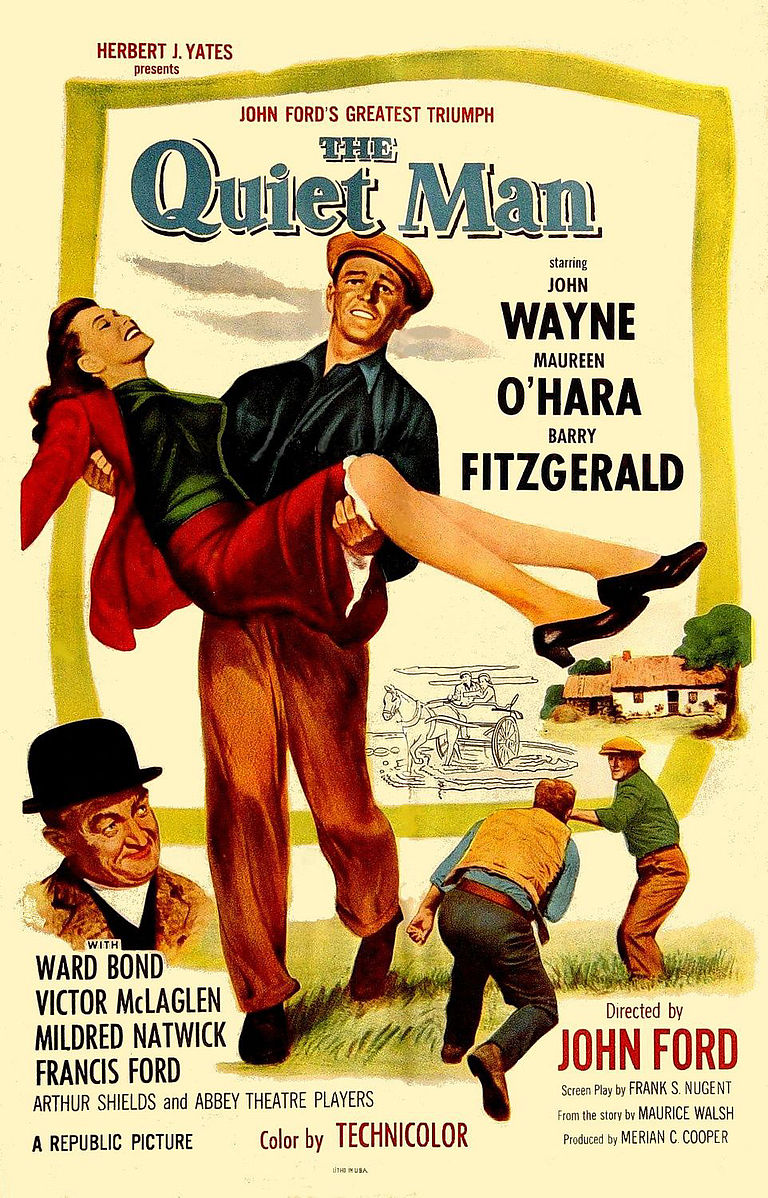
« L’Homme tranquille » (1952) raconte l’histoire de Sean Thornton, un boxeur américain au passé trouble qui retourne dans sa terre ancestrale d’Innisfree, en Irlande, en quête de paix. Il achète la vieille ferme familiale, au grand dam de « Red » Will Danaher, un tyran local qui voulait également la terre.
Sean tombe amoureux de Mary Kate, la fougueuse sœur de Will. Ils se marient, mais leur bonheur est de courte durée. Furieux que Sean ait acheté la ferme et épousé Mary Kate, Will retient la dot de cette dernière. Sean refuse dans un premier temps de se battre contre Will, déterminé à éviter la violence, mais Mary Kate considère la dot comme un symbole de sa valeur et se sent profondément insultée.
Le conflit s’intensifie, alimenté par la tradition et les malentendus. Mary Kate pense que Sean ne l’aime pas assez pour se battre pour sa dot. Sean est aux prises avec son passé et son désir d’éviter les bagarres.
Finalement, après l’intervention des habitants, Sean est poussé à affronter Will. Les deux hommes se lancent dans une bagarre légendaire et prolongée qui s’étend à travers champs et villages, attirant l’attention de toute la communauté. À la fin du combat, Will, vaincu et épuisé, cède finalement et donne sa dot à Mary Kate.
Le film se termine avec Sean et Mary Kate réconciliés, leur amour renforcé par le fait qu’ils ont surmonté leurs différences et embrassé leur héritage irlandais commun. Sean trouve la paix en Irlande et Mary Kate trouve le bonheur dans son mariage.
Plusieurs facteurs contribuent au statut légendaire du combat entre Sean Thornton et Will Danaher dans « L’Homme tranquille » :
Sa durée et son ampleur : le combat est exceptionnellement long et interminable, s’étendant sur une distance considérable à travers la campagne irlandaise. Cette durée prolongée et la vaste zone couverte la rendent mémorable et visuellement impressionnante.
Ses éléments comiques : Bien que violente, la bagarre intègre également de l’humour burlesque et des réactions exagérées de la part des spectateurs. Ce mélange de brutalité et de comédie est caractéristique du film et contribue à son statut d’icône.
L’implication de la communauté : Toute la communauté d’Innisfree s’implique, agissant en tant que spectateurs et offrant des commentaires. Cette participation communautaire renforce l’importance de la bagarre en tant que spectacle public.
Symbolisme : Au-delà du conflit physique, le combat représente un choc des valeurs et la résolution d’une querelle de longue date. Le pacifisme initial de Sean et son acceptation finale de la violence comme un mal nécessaire ajoutent de la profondeur à la confrontation. La dot devient une représentation symbolique du respect et de la valeur de Mary Kate.
Technique cinématographique : La mise en scène de John Ford et la cinématographie du film jouent un rôle crucial dans l’élévation du combat au rang de légende. L’utilisation de plans larges, de gros plans et de séquences d’action soigneusement chorégraphiées crée une expérience visuelle dynamique et captivante. La musique joue également un rôle important dans la création d’un sentiment d’excitation et d’anticipation.
Impact culturel : « L’Homme tranquille » est un film très apprécié, en particulier au sein des communautés irlandaises et irlandaises-américaines. Le combat est devenu un symbole emblématique de la masculinité irlandaise, bien qu’il soit souvent considéré avec humour et réflexion critique.
En substance, le statut légendaire de ce combat vient de la combinaison de sa durée, de ses éléments comiques, de l’implication de la communauté, de sa signification symbolique et de la réalisation magistrale du film, qui contribuent tous à son impact durable sur la culture populaire.
La dramaturgie de « L’Homme tranquille » repose sur un mélange fascinant d’éléments narratifs classiques, de thèmes culturels et de conflits axés sur les personnages. En voici une analyse :
Exposition : Le film commence par présenter l’histoire de Sean Thornton, un boxeur hanté par un accident tragique survenu aux États-Unis. Son arrivée à Innisfree, sa terre natale ancestrale, introduit le décor et laisse entrevoir son désir de paix et de nouveau départ. Nous faisons également rapidement la connaissance de « Red » Will Danaher, une figure locale puissante et quelque peu intimidante.
Incident déclencheur : L’achat par Sean de White O’Mornin’, la ferme ancestrale, est le catalyseur initial. Cet acte contrarie directement Will Danaher, qui voulait également la terre. De plus, l’attirance de Sean pour Mary Kate, la sœur de Will, ajoute une autre couche de conflit.
Action montante : La cour de Sean et Mary Kate se déroule malgré la désapprobation et l’ingérence de Will. Leur mariage est suivi du refus de la dot de Mary Kate, qui devient un point central de conflit. La réticence de Sean à se battre contre Will frustre Mary Kate, créant des tensions au sein de leur mariage. L’action montante est ponctuée de scènes comiques et de l’introduction de personnages secondaires hauts en couleur qui contribuent à l’atmosphère vibrante d’Innisfree.
Point culminant : le point culminant est la bagarre légendaire entre Sean et Will. Cette confrontation prolongée représente non seulement une bataille physique, mais aussi une lutte symbolique pour l’honneur, la tradition et le respect. C’est un moment charnière où Sean affronte son passé et s’affirme au sein de la communauté.
Action décroissante : après la bagarre, Will Danaher finit par céder et donne à Mary Kate sa dot. Épuisés mais réconciliés, Sean et Mary Kate rentrent chez eux, leur relation renforcée par cette épreuve.
Résolution : Le film se termine avec Sean et Mary Kate embrassant leur avenir ensemble, trouvant la paix et le bonheur à Innisfree. Sean a surmonté ses démons du passé et Mary Kate a retrouvé un sentiment de sécurité et de respect. La résolution est festive, réaffirmant l’importance de la communauté, de l’amour et de l’acceptation de son héritage.
Éléments dramaturgiques clés :
Conflit : Le film est animé par de multiples niveaux de conflit : interne (le traumatisme passé de Sean), externe (Sean contre Will) et interpersonnel (Sean contre Mary Kate).
Thèmes : Les thèmes principaux incluent la recherche de la paix, l’importance de la communauté, le choc entre les cultures américaine et irlandaise, le rôle de la tradition et les complexités de l’amour et du mariage.
Arcs de caractère : Sean subit une transformation importante, passant d’un étranger troublé cherchant du réconfort à un membre intégré de la communauté. Mary Kate connaît également une évolution, apprenant à équilibrer son esprit fougueux avec son amour pour Sean. Will, bien qu’il ne subisse pas une transformation complète, est quelque peu humilié à la fin.
Symbolisme : la dot, la ferme White O’Mornin’ et même la pluie ont tous un poids symbolique, représentant différents aspects de la culture irlandaise, de l’identité et des états intérieurs des personnages.
Mélange des genres : le film mélange avec succès des éléments de romance, de comédie et de drame, créant une expérience visuelle unique et engageante.
En bref, la dramaturgie de « The Quiet Man » est habilement conçue, utilisant une combinaison de structures narratives classiques, un riche développement des personnages et un symbolisme évocateur pour explorer les thèmes universels de l’amour, de la communauté et de la recherche de la paix.
Les rôles secondaires dans « The Quiet Man » sont bien plus que de simples remplisseurs d’arrière-plan ; ils font partie intégrante de la profondeur thématique du film et contribuent de manière significative à sa signification globale. Voici comment :
Représentation de la communauté : Les personnages secondaires incarnent collectivement l’esprit et les valeurs de la communauté irlandaise. Ils représentent les traditions, les coutumes et la dynamique sociale d’Innisfree, soulignant l’importance de l’appartenance et l’interdépendance de ses habitants. Des personnages comme le père Lonergan, Michaleen Oge Flynn et les différents villageois offrent une mosaïque de personnalités et de perspectives qui enrichissent le récit.
Comédie et commentaire social : Des personnages comme Michaleen Oge Flynn apportent une touche comique, mais offrent également un commentaire social subtil. Le rôle de Michaleen en tant qu’entremetteuse, commère et commentatrice des événements offre un aperçu humoristique mais perspicace des valeurs et des préjugés de la communauté. Ses singeries soulignent souvent les complexités des normes sociales irlandaises et les pressions auxquelles sont confrontées les personnes au sein de la communauté.
Renforcement des normes culturelles : Les personnages secondaires renforcent et remettent activement en question les normes culturelles. Ils incarnent les attentes traditionnelles en matière de mariage, de famille et d’honneur. Leurs réactions à la relation entre Sean et Mary Kate mettent en évidence l’importance de la dot et les pressions sociétales qui l’entourent. Des personnages comme la veuve Tillane représentent les femmes les plus indépendantes et les plus affirmées de la communauté, remettant subtilement en question les rôles traditionnels des hommes et des femmes.
Boussole morale et guide : Certains personnages secondaires servent de boussole morale ou de guide aux personnages principaux. Le père Lonergan, le prêtre local, offre des conseils et agit comme médiateur dans les conflits. Sa présence rappelle au public l’importance de la foi et du pardon. Le soutien des villageois à la réconciliation de Sean et Mary Kate souligne la capacité de la communauté à faire preuve de compassion et de compréhension.
Thèmes amplifiés : Les rôles secondaires amplifient les thèmes du film que sont la tradition, la communauté et l’identité culturelle. Leurs actions et interactions soulignent l’importance de préserver les coutumes irlandaises et les défis de l’adaptation à l’évolution des temps. Le contraste entre les origines américaines de Sean et l’identité irlandaise profondément enracinée des villageois souligne l’exploration des différences culturelles et le processus d’intégration.
Ajouter du réalisme et de l’authenticité : Les personnages secondaires ajoutent une couche de réalisme et d’authenticité au film. Leurs accents, leurs manières et leurs interactions créent une représentation crédible de la vie rurale irlandaise dans les années 1920. Cette authenticité renforce l’impact émotionnel du film et permet au public de se connecter à l’histoire à un niveau plus profond.
En conclusion, les rôles secondaires dans « L’Homme tranquille » ne sont pas simplement décoratifs ; ils sont essentiels à la profondeur thématique du film, ajoutant des couches de sens, de commentaire social et de richesse culturelle. Ils donnent vie à la communauté d’Innisfree et contribuent à l’attrait durable du film en tant que célébration de l’héritage irlandais et des complexités des relations humaines.
La dernière scène de « L’Homme tranquille » est un moment de joyeuse réconciliation et de célébration communautaire. En voici une description :
Sean et Mary Kate retournent à leur cottage, White O’ Mornin’, après la légendaire bagarre avec Will Danaher. Mary Kate tient l’argent de sa dot, qui est maintenant secondaire au fait que Sean était prêt à se battre pour son honneur et leur mariage. Ils entrent ensemble chez eux, le visage rayonnant de bonheur et de satisfaction.
À l’intérieur de la maison, la communauté d’Innisfree est réunie pour les accueillir. L’atmosphère est festive et joyeuse. Il y a de la musique, des rires et un sentiment de joie partagée. Sean et Mary Kate sont chaleureusement accueillis par le père Lonergan, Michaleen Oge Flynn et les autres villageois.
La scène met l’accent sur la réconciliation non seulement entre Sean et Mary Kate, mais aussi sur l’acceptation de Sean par la communauté. Il n’est plus un étranger, mais a fait ses preuves en défendant sa femme et en s’engageant, bien qu’à contrecœur au début, dans leurs traditions.
Le plan final montre Sean et Mary Kate enlacés, symbolisant leur amour et leur avenir à Innisfree. L’impression générale est celle de la chaleur, du bonheur et d’un sentiment d’appartenance. C’est une réaffirmation de l’importance de la communauté, de l’amour et de l’acceptation de son héritage. Le film se termine sur une note définitivement heureuse et pleine d’espoir.
“The Quiet Man, film 1952
“The Quiet Man” (1952) tells the story of Sean Thornton, an American boxer with a troubled past who returns to his ancestral homeland of Innisfree, Ireland, seeking peace. He purchases his family’s old farm, much to the chagrin of “Red” Will Danaher, a local bully who also wanted the land.
Sean falls in love with Will’s fiery sister, Mary Kate. They marry, but their happiness is short-lived. Will, furious that Sean bought the farm and married Mary Kate, withholds Mary Kate’s dowry. Sean initially refuses to fight Will, determined to avoid violence, but Mary Kate views the dowry as a symbol of her worth and feels deeply insulted.
The conflict escalates, fueled by tradition and misunderstandings. Mary Kate believes Sean doesn’t love her enough to fight for her dowry. Sean struggles with his past and his desire to avoid fighting.
Ultimately, after some intervention from the locals, Sean is goaded into confronting Will. The two men engage in a legendary, protracted fistfight that spans fields and villages, drawing the attention of the entire community. By the end of the fight, Will, defeated and exhausted, finally relents and gives Mary Kate her dowry.
The film concludes with Sean and Mary Kate reconciled, their love strengthened by overcoming their differences and embracing their shared Irish heritage. Sean finds peace in Ireland, and Mary Kate finds happiness in her marriage.
Several factors contribute to the legendary status of the fight between Sean Thornton and Will Danaher in “The Quiet Man”:
Its Length and Scale: The fight is unusually long and drawn-out, spanning a considerable distance across the Irish countryside. This extended duration and the vast area covered make it memorable and visually impressive.
Its Comedic Elements: While violent, the fight also incorporates slapstick humor and exaggerated reactions from onlookers. This blend of brutality and comedy is characteristic of the film and contributes to its iconic status.
The Community’s Involvement: The entire community of Innisfree becomes involved, acting as spectators and offering commentary. This communal participation reinforces the fight’s significance as a public spectacle.
Symbolism: Beyond the physical conflict, the fight represents a clash of values and the resolution of a long-standing feud. Sean’s initial pacifism and eventual acceptance of violence as a necessary evil add depth to the confrontation. The dowry becomes a symbolic representation of respect and Mary Kate’s worth.
Filmmaking Technique: John Ford’s direction and the film’s cinematography play a crucial role in elevating the fight to legendary status. The use of wide shots, close-ups, and carefully choreographed action sequences create a visually dynamic and engaging experience. The music also plays an important role in creating a sense of excitement and anticipation.
Cultural Impact: “The Quiet Man” is a beloved film, particularly within Irish and Irish-American communities. The fight has become an iconic symbol of Irish masculinity, albeit one that is often viewed with both humor and critical reflection.
In essence, the fight’s legendary status comes from a combination of its length, comedic elements, the community’s involvement, its symbolic meaning, and the film’s masterful execution, all contributing to its lasting impact on popular culture.
The dramaturgy of “The Quiet Man” is built on a compelling blend of classic storytelling elements, cultural themes, and character-driven conflict. Here’s a breakdown:
Exposition: The film begins by establishing Sean Thornton’s backstory as a boxer haunted by a tragic accident in the United States. His arrival in Innisfree, his ancestral homeland, introduces the setting and hints at his desire for peace and a new beginning. We also quickly learn about “Red” Will Danaher, a powerful and somewhat intimidating local figure.
Inciting Incident: Sean’s purchase of White O’ Mornin’, the ancestral farm, is the initial catalyst. This act directly antagonizes Will Danaher, who also wanted the land. Furthermore, Sean’s attraction to Mary Kate, Will’s sister, adds another layer of conflict.
Rising Action: The courtship of Sean and Mary Kate unfolds amidst Will’s disapproval and interference. Their marriage is followed by the withholding of Mary Kate’s dowry, which becomes a central point of conflict. Sean’s reluctance to fight Will frustrates Mary Kate, creating tension within their marriage. The rising action is punctuated by comedic scenes and the introduction of colorful supporting characters who contribute to the vibrant atmosphere of Innisfree.
Climax: The climax is the legendary fistfight between Sean and Will. This extended confrontation represents not only a physical battle but also a symbolic struggle over honor, tradition, and respect. It’s a pivotal moment where Sean confronts his past and asserts himself within the community.
Falling Action: After the fight, Will Danaher finally relents and gives Mary Kate her dowry. Exhausted but reconciled, Sean and Mary Kate return home, their relationship strengthened by the ordeal.
Resolution: The film concludes with Sean and Mary Kate embracing their future together, finding peace and happiness in Innisfree. Sean has overcome his past demons, and Mary Kate has gained a renewed sense of security and respect. The resolution is celebratory, reaffirming the importance of community, love, and embracing one’s heritage.
Key Dramaturgical Elements:
Conflict: The film is driven by multiple layers of conflict: internal (Sean’s past trauma), external (Sean vs. Will), and interpersonal (Sean vs. Mary Kate).
Themes: Prominent themes include the search for peace, the importance of community, the clash between American and Irish cultures, the role of tradition, and the complexities of love and marriage.
Character Arcs: Sean undergoes a significant transformation, evolving from a troubled outsider seeking solace to an integrated member of the community. Mary Kate also experiences growth, learning to balance her fiery spirit with her love for Sean. Will, while not undergoing a complete transformation, is somewhat humbled by the end.
Symbolism: The dowry, White O’ Mornin’ farm, and even the rain all carry symbolic weight, representing different aspects of Irish culture, identity, and the characters’ internal states.
Genre Blending: The film successfully blends elements of romance, comedy, and drama, creating a unique and engaging viewing experience.
In short, the dramaturgy of “The Quiet Man” is skillfully crafted, using a combination of classic narrative structures, rich character development, and evocative symbolism to explore universal themes of love, community, and the search for peace.
The supporting roles in “The Quiet Man” are far more than just background filler; they are integral to the film’s thematic depth and contribute significantly to its overall meaning. Here’s how:
Community Representation: The supporting characters collectively embody the spirit and values of the Irish community. They represent the traditions, customs, and social dynamics of Innisfree, highlighting the importance of belonging and the interconnectedness of its inhabitants. Characters like Father Lonergan, Michaleen Oge Flynn, and the various villagers provide a tapestry of personalities and perspectives that enrich the narrative.
Comedic Relief and Social Commentary: Characters like Michaleen Oge Flynn provide comedic relief but also offer subtle social commentary. Michaleen’s role as a matchmaker, gossipmonger, and commentator on events provides a humorous yet insightful glimpse into the community’s values and prejudices. His antics often underscore the complexities of Irish social norms and the pressures faced by individuals within the community.
Reinforcing Cultural Norms: The supporting characters actively reinforce and challenge cultural norms. They embody traditional expectations regarding marriage, family, and honor. Their reactions to Sean and Mary Kate’s relationship highlight the importance of the dowry and the societal pressures surrounding it. Characters like Widow Tillane represent the more independent and assertive women in the community, subtly challenging traditional gender roles.
Moral Compass and Guidance: Some supporting characters serve as a moral compass or provide guidance to the main characters. Father Lonergan, the local priest, offers counsel and acts as a mediator in conflicts. His presence reminds the audience of the importance of faith and forgiveness. The villagers’ eventual support for Sean and Mary Kate’s reconciliation underscores the community’s capacity for compassion and understanding.
Amplifying Themes: The supporting roles amplify the film’s themes of tradition, community, and cultural identity. Their actions and interactions highlight the importance of preserving Irish customs and the challenges of adapting to changing times. The contrast between Sean’s American background and the villagers’ deeply rooted Irish identity underscores the film’s exploration of cultural differences and the process of integration.
Adding Realism and Authenticity: The supporting characters add a layer of realism and authenticity to the film. Their accents, mannerisms, and interactions create a believable portrayal of rural Irish life in the 1920s. This authenticity enhances the film’s emotional impact and allows the audience to connect with the story on a deeper level.
In conclusion, the supporting roles in “The Quiet Man” are not merely decorative; they are essential to the film’s thematic depth, adding layers of meaning, social commentary, and cultural richness. They bring the community of Innisfree to life and contribute to the film’s enduring appeal as a celebration of Irish heritage and the complexities of human relationships.
The last scene of “The Quiet Man” is a moment of joyful reconciliation and communal celebration. Here’s a description:
Sean and Mary Kate return to their cottage, White O’ Mornin’, after the legendary fistfight with Will Danaher. Mary Kate is holding her retrieved dowry money, which is now secondary to the fact that Sean was willing to fight for her honor and their marriage. They enter their home together, their faces radiating happiness and contentment.
Inside the cottage, the community of Innisfree is gathered, waiting to welcome them back. The atmosphere is festive and celebratory. There’s music, laughter, and a sense of shared joy. Sean and Mary Kate are greeted warmly by Father Lonergan, Michaleen Oge Flynn, and the other villagers.
The scene emphasizes the reconciliation not only between Sean and Mary Kate but also the acceptance of Sean into the community. He is no longer an outsider but has proven himself through his willingness to stand up for his wife and his willingness to engage, albeit reluctantly at first, in their traditions.
The final shot is of Sean and Mary Kate together, embraced, symbolizing their love and their future in Innisfree. The overall feeling is one of warmth, happiness, and a sense of belonging. It’s a reaffirmation of the importance of community, love, and embracing one’s heritage. The film ends on a definitively happy and hopeful note.
The Quiet Man (1952) Pub Scene The Wild Colonial Boy
https://www.youtube.com/watch?v=1HCqRLTuOBw